


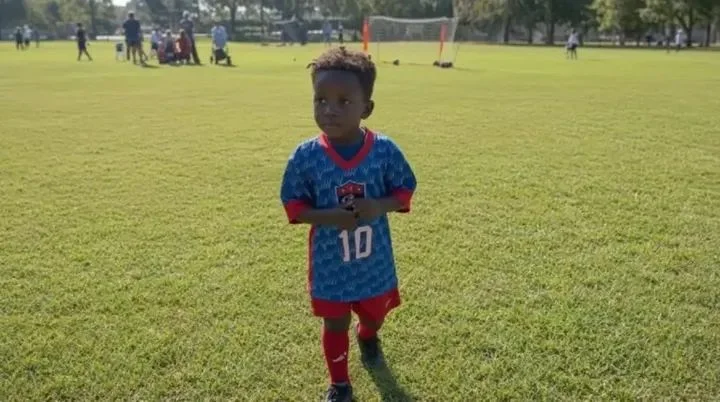
A video of 3-year-old Nevada scoring goals in an i9 Sports soccer game in Winter Park, Florida, spread widely over the weekend. The game took place on Saturday, October 24. The video prompted claims online that police were called because Nevada was playing too well. The Winter Park Police Department told [outlet] that a league official asked officers to respond to a disturbance between league officials and the player’s parents, Abass Suara writes for Bold Sports.
According to police, the league asked the family to leave and offered a refund. Officers say the matter was civil, no one was arrested or trespassed, and the family left voluntarily. The local i9 Sports program told [outlet] it is investigating the concerns and will not speculate while it establishes what happened. Those distinctions matter. But whatever the precise disagreement, a young child’s soccer game ended with police officers speaking to his family, and the incident now deserves a careful, public explanation.
Watch the clips and the first thing you notice is not size or speed. It’s comfort. Nevada keeps the ball close, shifts his weight to beat a defender, and looks up before he decides what to do. Most kids his age are still learning to kick without falling over. He is reading the game.
There is a playing style in him that people who follow the sport will recognize. The low center of gravity, the ball glued to the foot, the habit of running at defenders instead of away from them. Those were the traits that marked out a young Lionel Messi in Rosario, where as a small boy he was put in with older kids at Grandoli because he was simply too good for his own age group.
More Read



Lamine Yamal showed the same fearlessness on the ball long before Barcelona made him a teenage starter. Nobody can say at 3 where a career goes, and it would be unfair to load a child with that expectation. But the instincts are the same kind, and at his age they are genuinely rare.
Nevada should not have to turn an upsetting experience into a public performance to be valued. If this moment makes him a national treasure, let it be because adults choose to protect and support a child’s development, not because his family must repeatedly share a painful episode to secure attention.
Viral fame can bring opportunities, but it can also expose a very young child to pressure, constant scrutiny and expectations he is too young to understand. His well-being, his enjoyment of the game and his right to a normal childhood must come first.
The worst outcome here would be a family deciding the game is not worth the trouble. The best outcome is that Nevada becomes something the whole country gets behind, a kid people root for because they saw how he was treated and saw what he can do.
That is why this incident should prompt more than online debate. U.S. Soccer and youth sports leaders should treat it as a clarion call to build a real national system for exceptional young players, one that does three things well.
First, find them. Talent identification in this country still depends heavily on whether a family can afford the right club and the right showcase. A national approach would scout rec leagues, schools and community programs, the places where most kids actually play.
Second, protect them. Rec leagues and franchise programs need clear guidance on what to do when a child is far ahead of the group. The answer should be moving that player up or into a better environment, never removing him from the game and certainly never calling the police.
Third, promote them. Once a player is identified, there should be a funded, clearly marked path from local soccer to elite development, regardless of family income. Right now that path exists for some kids and not for others, and the dividing line is usually money.
A three-year-old does not need a professional contract or a promise of stardom. He needs patient coaching, safe and welcoming places to play, informed adults around him, and a pathway that can grow with him if his interest and ability continue.
What having no system costs us
Every country that wins in this sport has a way of catching its best kids early. Without that, talent rarely disappears dramatically. It just quietly stops. A fee goes unpaid, a family moves, or a coach decides a kid is a problem, and a player who could have worn the national team shirt drifts into something else.
The United States co-hosted the World Cup this summer with Canada and Mexico, and interest in the game here has never been higher. But the World Cup is a moment, and development is a decade. The players who will represent this country in 2038 and 2042 are toddlers and kindergartners right now. If the United States cannot recognize and hold onto a 3-year-old who is already outplaying 5-year-olds with instincts well beyond his age, it is fair to ask how many generational talents we never even hear about.
Look closely at the national team and a pattern shows up. Folarin Balogun was born in New York but moved to London as a toddler and came through Arsenal’s academy before choosing to play for the United States. Yunus Musah, also born in New York, grew up in Italy and England and developed at Arsenal and Valencia. Tim Weah started in the New York Red Bulls system but finished his education at Paris Saint-Germain from age 14. Christian Pulisic left Pennsylvania for Borussia Dortmund at 16, a move made possible by a European passport through his family.
Nobody can prove what these players would have become had they stayed in the United States the whole way. But it is hard to ignore how many of America’s best were shaped, at least in part, by systems that identify talent early, train it daily and pay for it. They became American internationals in large part because someone abroad built the pathway for them.
American youth soccer runs largely on a pay-to-play model. Clubs charge fees, and the better the club, the higher the bill. That alone filters out a huge share of talented kids before anyone with real expertise ever sees them play.
What happened in Winter Park adds a second barrier on top of the first. It is one thing for a family to be priced out. It is another for a family that has paid, shown up and done everything right to be asked to leave because their child is too good. If the message to parents is that exceptional talent gets you shown the door rather than nurtured, fewer families will stick with the game. And the ones who leave first will be the ones who were already stretching to afford it.
In 2024, families of youth soccer players spent an average of $910 a year, up from $537 in 2019, according to an Aspen Institute Project Play survey. That figure does not capture every family’s costs. Competitive teams can add registration, coaching, uniforms, equipment, tournament fees, gas, hotels and meals. Parents may also have to miss work, arrange childcare for siblings and spend long days driving to games.
For low- and middle-income households already balancing rent, food, healthcare and other bills, these demands can make sustained participation impossible. Once a child moves into competitive travel soccer, $5,000 to $10,000 a year is common when tournaments, gear and private training are added up. Parents who make that kind of sacrifice deserve encouragement. They should not be met with complaints, an order to leave and police officers on the sideline for the crime of raising a good player.
Families who make those sacrifices should not be discouraged by a system that has no clear next step for an unusually talented child. To play devil’s advocate for a moment, a recreational league may not be equipped to manage a large gap in ability between players. But it should have a fair, child-centered way to respond: speak respectfully with the family, explain the league’s concerns, and offer an appropriate alternative. Questions about playing time or team fit should never become a source of humiliation or confusion for a child.
European club systems offer examples of more structured development, with local clubs and academies creating progression routes for young players. Scouts watch local grassroots games. Many clubs run development centers for kids as young as 5 or 6, and formal academies usually begin taking players around 7 or 8. Barcelona brought Lamine Yamal into La Masia at 7.
Once a player is in, the club generally carries the cost. Training is free. Coaching is professional. As players get older, clubs often help with schooling, transport and housing, and for the most promising prospects some will help families relocate so a child can stay close to home while he trains. A family with a gifted son is not left to figure it out alone or empty its savings. The club wants that player to succeed, because his success is its success.
A 3-year-old like Nevada would not be signed tomorrow in Europe either. But he would be noticed, encouraged and kept in a good environment until he was old enough to step into a structured pathway. That is the difference. Over there, a kid this good is someone to keep. Here, he was someone to remove.
My recommendations
U.S. Soccer should publicly affirm the family’s right to respectful treatment and help identify an age-appropriate, progressive development pathway for Nevada’s future.
The Winter Park Police Department should acknowledge the distress the encounter caused and apologize to the child and family for the experience.
i9 Sports should give a full public explanation of the league’s decision, what led to officers being contacted, and what steps it will take to handle similar situations involving young children. Parents across the country use these programs. They deserve to know exactly what happened, why the family was asked to leave and what the league will change so it never happens again.
Nevada’s parents should also have access to qualified, independent advice. A reputable sports agent or youth player management professional could help them understand coaching options, safeguarding, media exposure, contracts and the risks of early commercialization. If they choose to manage his development themselves, they will need to learn the basics and find reliable guidance on those same issues. At three, Nevada does not need a publicity machine. He needs adults who put his safety and happiness first.
This incident should not end with a viral clip, a refund or a social media argument. It should lead to a better way to welcome exceptional children into the game: one that recognizes talent, respects families, lowers financial barriers and gives young players room to grow at their own pace. That is how America can turn a troubling moment into a lasting opportunity for Nevada and for the many gifted children whose names may never trend online.
© Bold Sports Media. All rights reserved. If sharing, kindly credit Bold Sports as the source and include a link to the original post. Unauthorised use is prohibited.