


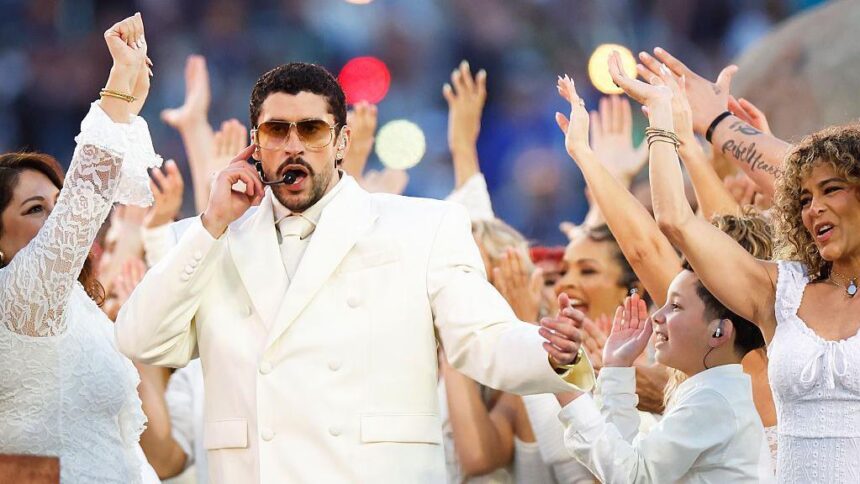
The Seattle Seahawks’ 29-13 victory over the New England Patriots at Super Bowl LX will be remembered for Seattle’s defensive masterclass. But the real story of this year’s championship extends far beyond the final score. From a historic halftime show to record-breaking advertising revenue, Super Bowl 2026 represents a critical inflection point in the NFL’s transformation into a truly global, culturally inclusive sporting empire.
Bad Bunny: The Right Choice at the Right Time
And then came halftime. Bad Bunny‘s performance as the first predominantly Spanish-language artist to headline the Super Bowl halftime show sparked predictable controversy, with President Trump posting on Truth Social, calling it a “terrible choice.” But strip away the controversy, Bad Bunny’s selection emerges as both culturally necessary and strategically brilliant.
The criticism fundamentally misunderstands demographic reality. Latinos now represent one in five Americans, 68 million people, or 20% of the U.S. population, according to the Pew Research Center, marking a historic milestone reached in 2024. This isn’t a marginal demographic; it’s the fastest-growing population group in America, projected to reach 26.9% by 2060.
In California and Texas, Latinos comprise 41% and 40% of the population respectively. They accounted for 71% of U.S. population growth between 2022 and 2023. Spanish is the most common non-English language in the United States, with 13% of Americans speaking it at home. Bad Bunny’s performance wasn’t pandering; it reflected America as it actually exists today.
More Read





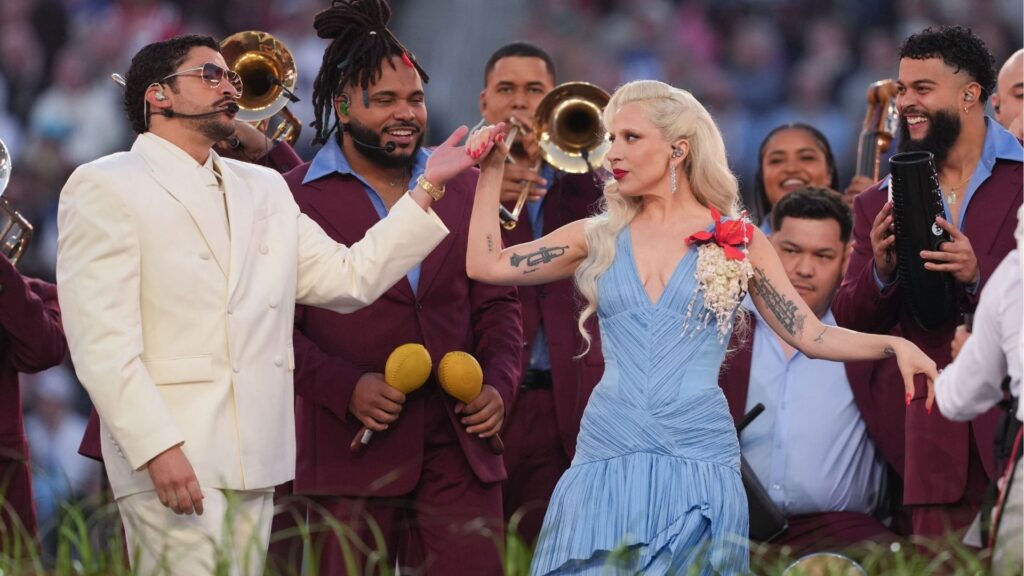
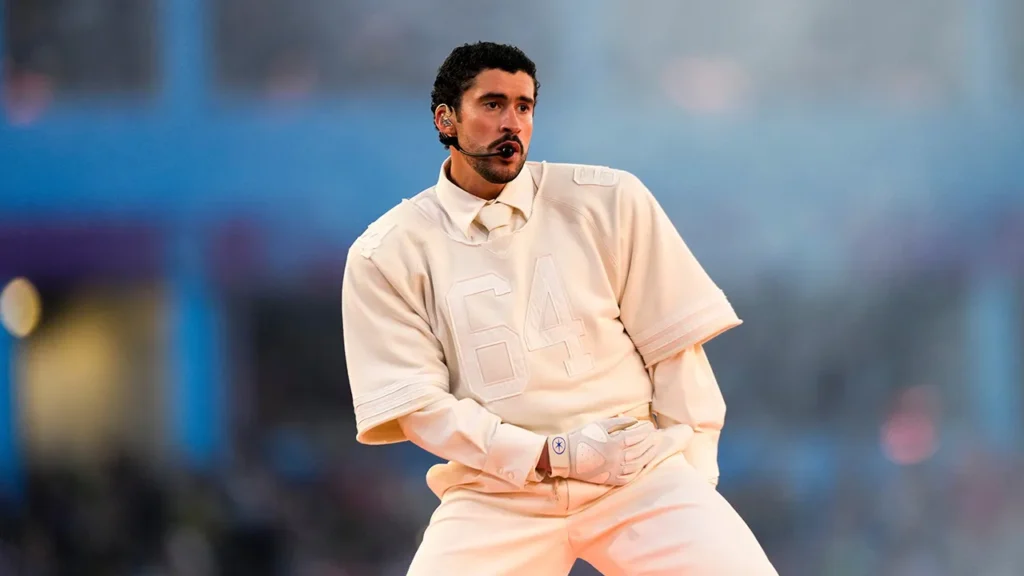
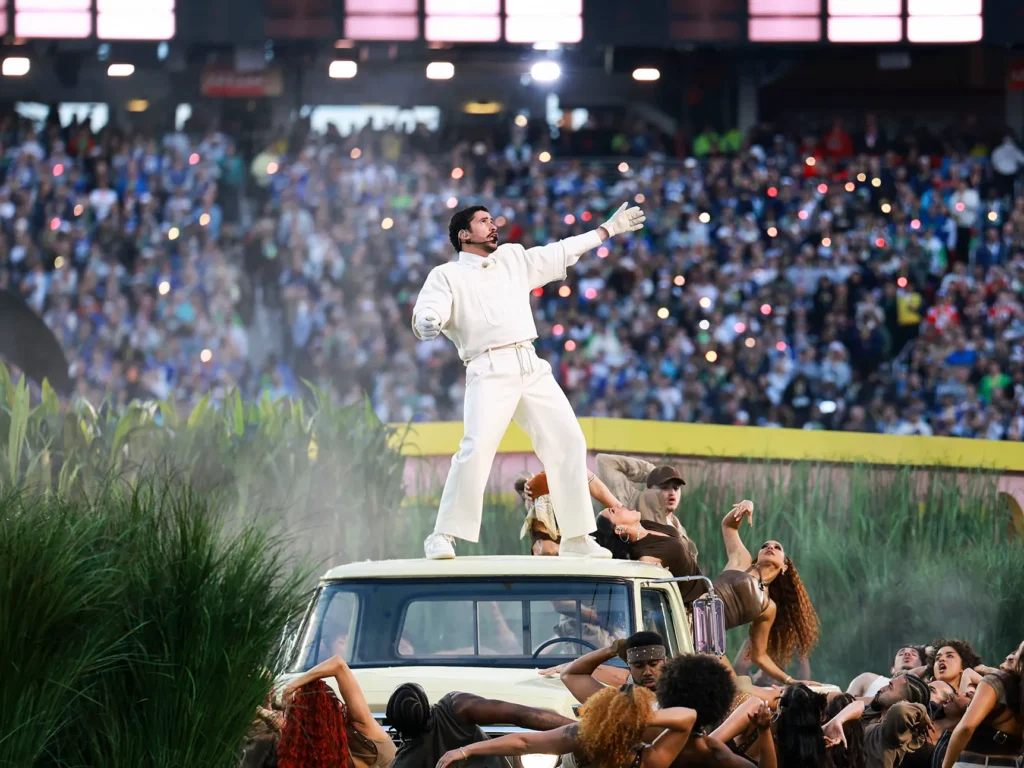
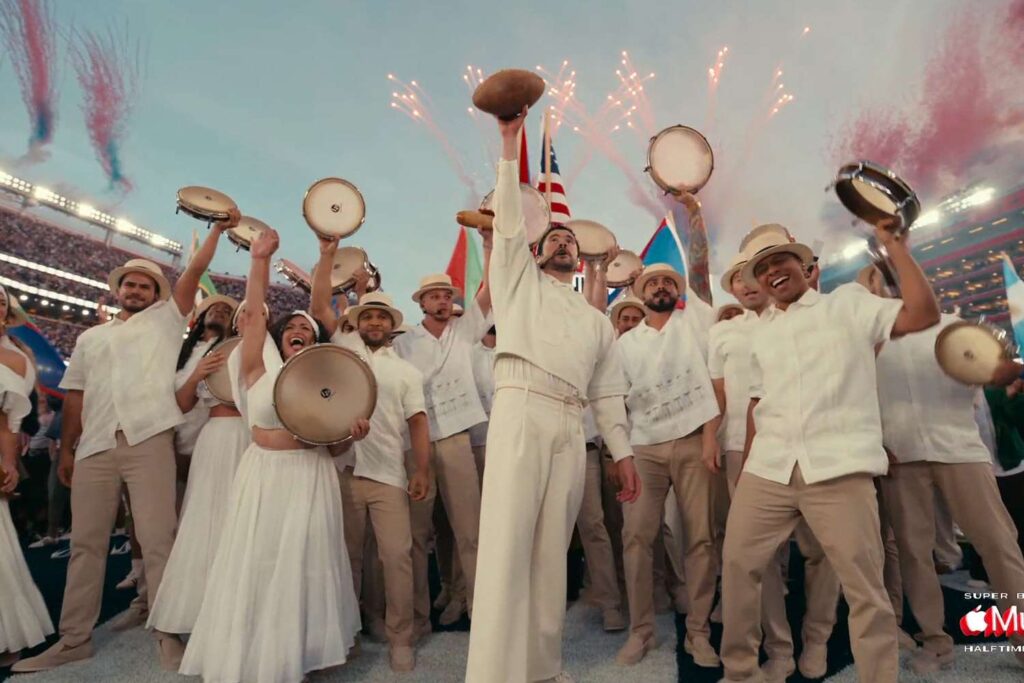
The halftime show itself delivered on every level. Sporting an all-white outfit and holding a football, Bad Bunny created a 13-minute cinematic celebration of Latino culture, featuring piragua stands, dominoes, an actual wedding reception, and authentic elements of the Puerto Rican community. Guest appearances from Lady Gaga (performing a Latin-inspired “Die With a Smile”) and Ricky Martin elevated the spectacle. At the same time, celebrities such as Pedro Pascal, Cardi B, Jessica Alba, and Karol G filled the stage.
Critics who dismissed the show because they couldn’t understand the lyrics missed the point entirely. As Bad Bunny himself said, “People only have to worry about dancing. They don’t even have to learn Spanish. Better they learn to dance.” Hollywood Reporter’s review called it “the most impressively conceived and executed Super Bowl halftime production” in history, praising its narrative complexity and cultural celebration.
Latino Representation and NFL Globalization and Its Relevance
Bad Bunny’s halftime performance wasn’t occurring in a vacuum; it aligned perfectly with the NFL’s aggressive international expansion strategy, particularly in Latin America. The league played seven international games in the 2025 season, including a historic first in São Paulo, Brazil, and has announced a return to Estadio Banorte in Mexico City for 2026, 2027, and 2028. Mexico represents the NFL’s largest fanbase outside the United States, with approximately 40 million fans.
The NFL’s Latin American engagement dates back to 2005, when the first regular-season game outside the U.S. was played at Estadio Azteca in Mexico City, drawing a record 103,467 spectators for a matchup marketed as “Fútbol Americano.” After successful games in São Paulo in 2024 and 2025, and the planned expansion to Rio de Janeiro’s Maracanã Stadium in 2026, the NFL is clearly targeting Spanish and Portuguese-speaking markets as critical growth opportunities.
The league’s 2025 season demonstrated unprecedented global ambition, with seven international games spanning five countries: Brazil (São Paulo), Ireland (Dublin), England (London, three games), Germany (Berlin), and Spain (Madrid). The 2026 season will escalate further to nine international games across four continents, including debuts in Paris, France, and Melbourne, Australia, alongside continued commitments to Mexico City, Munich, Berlin, and London.
This isn’t casual dabbling in foreign markets; it’s a systematic campaign to establish American football as a global sport. The NFL has assigned international marketing territories to all 32 teams, established NFL Academy campuses in England and Australia, and created the International Player Pathway program to develop non-U.S. talent. Mexico alone hosts 40 million NFL fans, representing roughly one-eighth of the entire U.S. population.
Having Bad Bunny, fresh off winning Album of the Year at the Grammys, headline the halftime show sends an unmistakable message to these markets: you’re not peripheral to American football; you’re central to its future. This isn’t cultural imperialism; it’s cultural acknowledgment.
Diversity in the Field
The cultural shift extends to the field itself. Venezuelan-born kicker Andy Borregales became the first Venezuelan player to take the field in a Super Bowl, representing the New England Patriots. Christian Gonzalez, a cornerback with Colombian heritage, and Jaylinn Hawkins, a safety of Panamanian descent, also played for the Patriots. These players embody the NFL’s growing international character.
While over a quarter of foreign-born NFL players come from Africa, the league’s International Player Pathway program, launched in 2016, has created systematic routes for talent from Europe, Latin America, and beyond to reach the NFL. This isn’t tokenism; it’s talent optimization on a global scale aimed at global marketability and relevance.
The Money Game: Advertising Revenue Hits New Heights
Let’s turn to the numbers, because they tell a compelling story about the Super Bowl’s commercial might. This year’s 30-second advertising slots averaged $8 million, with premium placements exceeding $10 million. This represents a 14% increase from 2024’s $7 million average and continues an upward trajectory that shows no signs of slowing. The Super Bowl remains the most coveted real estate in American advertising.
The total advertising haul likely approached $550-600 million, a staggering sum that dwarfs most entertainment properties. What’s particularly striking is how advertisers have essentially declared that fragmented media consumption hasn’t diminished the Super Bowl’s unique value proposition. In an era where viewers scatter across streaming platforms and traditional broadcasting struggles, the Super Bowl remains the last true mass gathering of American attention.
Tech and AI Surge While Automotive Retreats
The composition of this year’s advertisers reveals profound shifts in American economic power. Technology and artificial intelligence companies emerged as the dominant force, with at least 16 tech companies securing spots. Google Gemini, OpenAI’s ChatGPT, Meta’s Oakley smart glasses, and Claude all competed for consumer mindshare, each presenting AI as an accessible tool for everyday life rather than an existential threat.
The most dramatic change, however, was in the automotive sector’s near-complete withdrawal. Once commanding 40% of Super Bowl advertising minutes in 2012, automakers accounted for just 7% by 2025, with only General Motors, Toyota, and Volkswagen appearing this year. This pullback reflects broader uncertainty in the automotive industry as it navigates the electric- vehicle transition, supply-chain disruptions, and changing consumer preferences.
Meanwhile, weight loss medications made their Super Bowl debut. The presence of GLP-1 medications in Super Bowl advertising marks a cultural inflection point, acknowledging that weight management drugs have moved from pharmaceutical obscurity to mainstream consumer products. This advertising evolution mirrors broader societal shifts in how Americans approach health, wellness, and medical intervention.
Sports Betting’s Calculated Presence
Sports betting platforms demonstrated strategic evolution rather than exponential growth in their Super Bowl advertising approach. While gambling is projected to hit a record $1.76 billion in wagers on this game alone, a 27% year-over-year increase, the advertising landscape showed restraint. FanDuel, DraftKings, and Fanatics Sportsbook made appearances, with Fanatics leveraging Kendall Jenner’s star power in its debut commercial, but the predicted deluge of betting ads didn’t materialize.
This is definitely progressive steps towards controlling gambling-related problems that have risen to unprecedented levels in the last 5 years since the state-level legalization of gambling in the United States. The NFL’s ban on advertising in prediction markets also signaled regulatory boundaries in an industry still finding its equilibrium.
This measured approach reflects market maturation, shifting the focus from brand awareness to customer retention and from targeting mass-market players to targeting high-value players. Another perspective is that, in a year featuring the Olympics and the World Cup, sports betting platforms are spreading their marketing budgets across multiple major events rather than concentrating everything on a single Sunday.
Bad Bunny was the Cultural Spice of the NFL Commercial Buffet
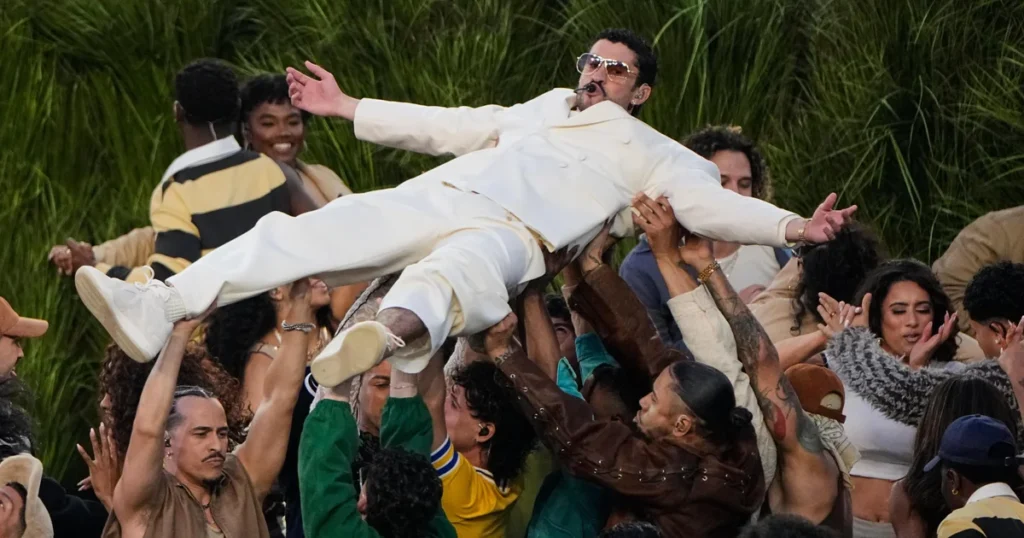
Super Bowl LX demonstrates that the NFL has successfully navigated two transformations simultaneously: monetizing its content in an increasingly fragmented media landscape while expanding its cultural aperture to reflect America’s demographic evolution. The $8-10 million advertising rates prove the first point; Bad Bunny’s triumphant halftime show proves the second.
Critics who resist this evolution are fighting demographic mathematics. The Latino population isn’t shrinking; it’s accelerating. The NFL’s international ambitions aren’t retreating; they’re expanding to nine games across four continents in 2026. American culture isn’t becoming less diverse; it’s becoming more accurately representative.
The NFL has always been astute at recognizing where power and money flow. The league’s embrace of Latino culture, international expansion, and technological innovation in its advertising base all point to the same conclusion: the NFL isn’t changing direction; it’s recognizing that the direction of America itself has changed.
For those who found Bad Bunny’s Spanish lyrics alienating, consider this: the Super Bowl now broadcasts on Telemundo in Spanish for millions of viewers who prefer it. Those viewers’ purchasing power is just as real, their fandom just as passionate. They represent the future of American football, and they’re not waiting for permission to claim their place.
The Seattle Seahawks won the Lombardi Trophy on Sunday night. But the real winner is the NFL’s globalization strategy and the recognition that American football is evolving into something richer, more diverse, and far more commercially powerful than ever. Anyone still questioning whether Bad Bunny was the right choice simply isn’t paying attention to the numbers, demographics, or financials.
© Bold Sports Media. All rights reserved. If sharing, kindly credit Bold Sports as the source and include a link to the original post. Unauthorised use is prohibited.