

For much of Nigeria’s Commonwealth Games history, boxing was considered a medal bank.
The country did not approach the sport merely hoping that one fighter might produce a surprise. Nigerian boxers travelled with legitimate expectations of reaching finals, winning titles and making significant contributions to the overall medal table.
That reputation was earned across generations.
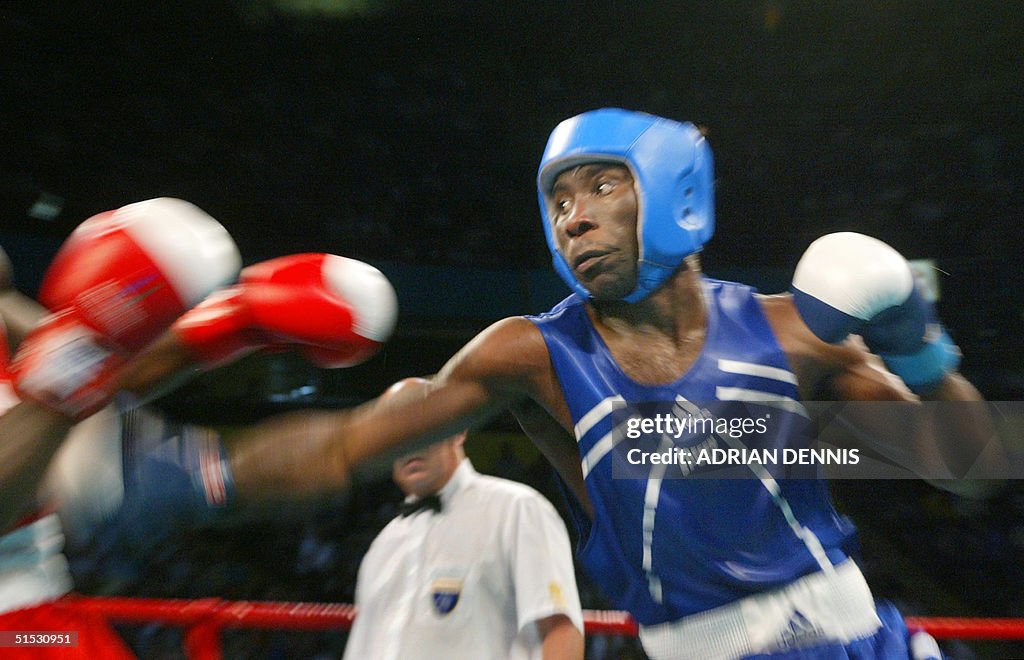
From Edward Ndukwu and Anthony Andeh in 1966 to Duncan Dokiwari in 1994 and Jegbefumere Albert in 2002, Nigerian fighters repeatedly stood at the top of the Commonwealth podium.
More Read



Glasgow 2026 however produced a very different outcome. With Nigeria entered six boxers entered for the games, none won a medal.
A traditional source of Nigerian medals
The all-time Commonwealth Games boxing table, updated after Birmingham 2022, places Nigeria seventh with 42 medals: 13 gold, seven silver and 22 bronze.
Only England, Canada, Scotland, Northern Ireland, Australia and South Africa had won more boxing gold medals at the Games. Commonwealth Sport also identifies boxing, alongside athletics, as one of Nigeria’s traditional sources of medals.
The history includes several particularly successful periods.
Ndukwu and Andeh won titles at Kingston 1966. Adeyemi Abayomi and Fatai Ayinla followed with two more gold medals in Edinburgh four years later.
Ndukwu became Nigeria’s only two-time Commonwealth boxing champion when he won again in 1974, this time at featherweight. Obisia Nwankpa also claimed gold at the same Games.
Nigeria’s strongest single boxing performance came at Brisbane 1982, where Joe Orewa, Peter Konyegwachie and Christopher Ossai won three titles.
Mohammed Sabo and David Defiagbon added two more gold medals in 1990 before Dokiwari became super-heavyweight champion in 1994.
Albert’s light-heavyweight victory in Manchester in 2002 remains Nigeria’s most recent Commonwealth boxing gold.
Nigeria’s Commonwealth Games boxing champions
| Year | Boxer | Division |
|---|---|---|
| 1966 | Edward Ndukwu | Bantamweight |
| 1966 | Anthony Andeh | Lightweight |
| 1970 | Adeyemi Abayomi | Lightweight |
| 1970 | Fatai Ayinla | Light-heavyweight |
| 1974 | Edward Ndukwu | Featherweight |
| 1974 | Obisia Nwankpa | Light-welterweight |
| 1982 | Joe Orewa | Bantamweight |
| 1982 | Peter Konyegwachie | Featherweight |
| 1982 | Christopher Ossai | Light-welterweight |
| 1990 | Mohammed Sabo | Bantamweight |
| 1990 | David Defiagbon | Welterweight |
| 1994 | Duncan Dokiwari | Super-heavyweight |
| 2002 | Jegbefumere Albert | Light-heavyweight |
The 13 titles were won by 12 boxers, with Ndukwu accounting for two. The divisions are listed by the weight-class names used at the respective Games.
How Nigeria’s Glasgow campaign ended
The warning signs appeared early.
Ayomide Foly Hassan lost 4-0 to Lesotho’s Refiloe Thai in the men’s 70kg round of 32. Abdulramon Abdulwahab was beaten 5-0 by Uganda’s Nuhu Batte in the men’s 65kg category.
David Akintola then suffered a 4-1 defeat to Tanzania’s Yusef Lucasi Changalewa in the men’s 80kg event.
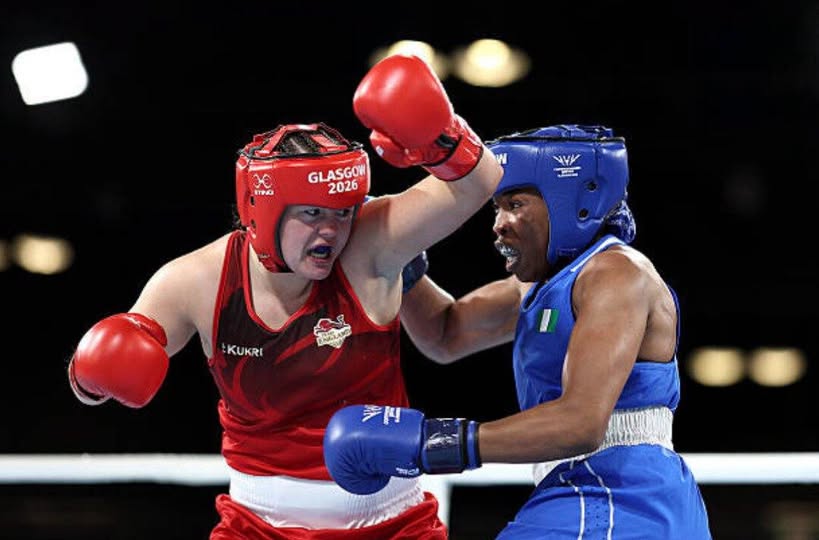
Ajishola Kadijat became the fourth Nigerian eliminated when she lost a close 3-2 split decision to Wales’ Helen Jones in the women’s 54kg round of 16.
That left Patricia Mbata and Blessing Orakwe as Nigeria’s final medal hopes.
Mbata lost her women’s 75kg quarter-final to England’s Mary Kate Smith. Orakwe was then beaten 3-2 by Australia’s Lekeisha Pergoliti in the women’s 70kg quarter-final.
Because boxing awards bronze medals to defeated semi-finalists, both Nigerians needed to win their quarter-finals to guarantee places on the podium.
Their defeats completed Nigeria’s medal-less campaign.
From six-gold target to no medals
The outcome was far removed from the expectations set before the Games.
In May, the Nigeria Boxing Federation said it was targeting 10 medals in Glasgow, six of them gold. The federation also expressed the belief that every boxer eventually selected should return with a medal.
Officials pointed to an early camping programme as evidence that the team would be properly prepared, although Nigeria had lost a pre-Games friendly against Ghana by four bouts to three.
While ambitious targets can be useful, they must be supported by evidence.
A six-gold projection suggested that Nigeria expected to produce one of its greatest Commonwealth boxing performances. The country instead recorded one of its poorest.
The gap between the promise and the final result therefore requires an explanation.
The decline did not begin in Glasgow
Nigeria’s failure in 2026 is more alarming when placed against the country’s history, but the decline in gold-medal success has been visible for years.
The country has not produced a Commonwealth boxing champion since Albert’s victory in 2002.
Nigeria won three bronze medals at Glasgow 2014 through Efetobor Apochi, Efe Ajagba and Edith Ogoke. Four years later, Yetunde Odunuga and Millicent Agboegbulem won two bronze medals at Gold Coast 2018.
The Birmingham 2022 team returned with four medals. Elizabeth Oshoba won silver, while Cynthia Ogunsemilore, Jacinta Umunnakwe and Ifeanyi Onyekwere claimed bronze.
That meant nine Nigerian boxers produced four medals in Birmingham. Four years later, the six-person Glasgow team produced none.
| Games | Nigeria’s boxing return |
|---|---|
| Glasgow 2014 | Three bronze |
| Gold Coast 2018 | Two bronze |
| Birmingham 2022 | One silver and three bronze |
| Glasgow 2026 | No medals |
The figures show that Nigeria remained capable of reaching the podium before Glasgow, but the country had already gone more than two decades without winning gold.
The 2026 result now raises a more serious question: is Nigeria losing its ability to produce Commonwealth medallists altogether?
Selection dispute adds another concern
Nigeria’s poor performance was followed by protests at the National Stadium in Lagos on Wednesday, where some boxers and coaches alleged favouritism and flaws in the selection process.
The protesters argued that athletes with stronger international records had been overlooked and called for the National Sports Commission and Nigeria Boxing Federation leadership to investigate.
The federation rejected the accusations. Its communications director said the team was selected through competitive trials and that the boxers received foreign training camps and the support required to compete. The NSC was also said to be examining the complaints.
The allegations do not prove that different selections would have produced medals.
They do, however, make transparency essential.
The federation should publish the criteria used to select the six boxers, the results of the trials and the competitive records considered by the technical team.
A credible review must separate dissatisfaction from evidence while ensuring that athletes believe selection is based on merit.
Preparation must mean more than camping
The review should also examine what happened after the boxers were selected.
How many high-level international bouts did each athlete contest before Glasgow? What calibre of sparring partners were available? How much experience did the technical team have against the styles Nigeria encountered at the Games?
It is possible to spend months in camp without receiving the competition exposure required for an international championship.
Boxers develop through bouts, not training sessions alone. They need to face opponents with different rhythms, defensive systems and tactical approaches before arriving at a competition where one poor round can end a medal campaign.
Nigeria’s 4-3 warm-up defeat to Ghana showed that the team still had work to do. A review should establish whether enough was done after that result to correct the weaknesses identified.
A review, not a blame exercise
The six athletes should not carry the entire responsibility for what happened in Glasgow.
They stepped into the ring and were defeated, but international performance is shaped long before the opening bell. Selection, coaching, sports science, competition exposure, funding and administration all contribute to the final result.
Nigeria needs an independent technical review covering the selection process, preparation programme, coaching decisions and performances in Glasgow.
The findings should be used to create a clear plan for the next African championships, Olympic qualification cycle and Commonwealth Games.
Boxing’s place in Nigerian sporting history is secure. The problem is that history does not win present-day bouts.
The medals earned by Ndukwu, Andeh, Ayinla, Konyegwachie, Defiagbon, Dokiwari and the other champions belong to them. Their success should be a standard for the current system, not a shield used to avoid difficult questions.
Nigeria once travelled to the Commonwealth Games expecting boxing medals.
After six boxers returned empty-handed from Glasgow, the task is to build a system worthy of that expectation again.
© Bold Sports Media. All rights reserved. If sharing, kindly credit Bold Sports as the source and include a link to the original post. Unauthorised use is prohibited.