

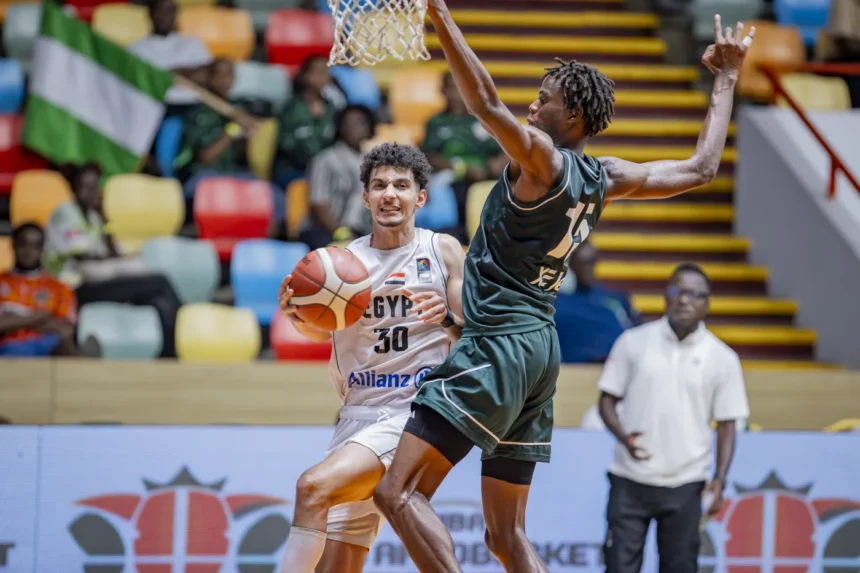
By the end of the first half against Egypt, Nigeria were still in the game.
The Junior D’Tigers trailed 56-43 in their opening match of the 2026 FIBA U18 AfroBasket in Abidjan. It was a difficult position against one of the strongest teams in African youth basketball, but Nigeria had competed.
Then the disadvantage began to show. Nigeria had seven players available. Two substitutes. No room for injuries, foul trouble or much rest.
Egypt pulled away after the break and won 95-68. FIBA’s account of the game was blunt: Nigeria fought for two quarters before running out of legs.
More Read






How a six-time African U18 champion arrived at a continental championship in that condition deserves more scrutiny than the scoreline.
BSN Sports reported on Thursday, citing sources close to FIBA Africa, that five Nigerian players had been ruled ineligible following MRI age-verification screening.
FIBA has confirmed that Nigeria played with seven players. It has not publicly said that five Nigerians failed the MRI screening, identified the affected players or explained when the tests were conducted.
The Nigeria Basketball Federation has also not publicly explained what happened.
That distinction matters.
An MRI eligibility result should not automatically be presented as proof that a player deliberately falsified his age. The players involved are teenagers and, without evidence of deception, the responsibility for explaining how Nigeria ended up in this position belongs with the adults running the programme.
And the preparation started long before Abidjan.
The plan looked comprehensive
In June, the NBBF announced what it called a comprehensive preparation programme for its U18 national teams.
There would be nationwide trials in Abuja, Lagos and Benin City on June 6 and 7.
The boys would enter camp later that month before travelling to Burkina Faso for the Zone 3 qualifiers. After qualification, another camp was planned for home-based players.
A separate evaluation camp for Nigerian players in the United States was scheduled for Chicago, followed by a final integration camp in Ivory Coast from July 27 to August 2.
On paper, Nigeria had almost two months to identify its players, establish their eligibility and prepare a final squad.
The boys then did their part.
Nigeria went through the Zone 3 qualifiers unbeaten, winning all four matches against Benin and Burkina Faso and scoring at least 96 points in each.
By July 11, the Junior D’Tigers had their ticket to Abidjan.
What happened afterwards is less clear.
The original NBBF schedule said selected Nigerian and diaspora players would converge in Ivory Coast from July 27 for the final stage of preparation.
Instead, 15 boys were called into another camp in Abuja which opened on July 28 at the Moshood Abiola National Stadium.
The NBBF said the final travelling squad would be selected according to performances in that camp.
There was also a firm instruction from NBBF Secretary General Amina Amanchi. Players were required to report with their passports, birth certificates and other documentation.
Nigeria, she said, needed to arrive in Abidjan “beyond reproach.” Five days later, on August 2, the teams arrived in Ivory Coast. Three days after that, Nigeria faced Egypt with seven players.
What do FIBA’s rules actually say?
FIBA Africa had already made age verification a priority before the championship.
At its board meeting in April, the regional body approved changes to the rules governing U16 and U18 competitions and specifically announced the introduction of MRI testing as part of its response to age irregularities in youth basketball.
But FIBA’s publicly available regulations are important for another reason: they place responsibility for eligibility squarely on the national federation.
Under FIBA Internal Regulations Book 3, federations must register players and provide birth certificates, passports and other required documentation.
For a U18 competition taking place in 2026, FIBA’s age calculation means an eligible player must have been born on or after January 1, 2008.
Article 3-157 says the national federation is “strictly liable” for the eligibility of the people it registers and for the accuracy and authenticity of the information supplied.
Articles 3-161 and 3-162 provide for identity and, where applicable, age verification before a competition under the supervision of the commissioner or technical delegate.
The publicly available Internal Regulations do not set out the detailed MRI protocol being used by FIBA Africa in these championships. FIBA Africa’s April announcement said a clear protocol would accompany the introduction of the tests.
That protocol, including exactly what constitutes an unsuccessful result and whether national federations were given a recognised procedure for conducting preliminary tests themselves, is something FIBA should clarify.
Could Nigeria have checked before travelling?
There is evidence that another African federation did exactly that as a precaution.
Before Namibia travelled to the Zone 6 U18 qualifier in July, its players underwent MRI scans in Windhoek. The Namibian federation said the scans formed part of the age-verification requirements communicated to it for the competition.
At the Zone 6 tournament itself, FIBA also had a doctor supervising MRI examinations, with the results sent to FIBA for analysis.
That does not establish that a privately arranged scan in Nigeria would have replaced FIBA’s official screening.
It does show that a federation could use pre-tournament MRI screening to identify potential eligibility problems before selecting a travelling squad.
Did the NBBF do that? There is no public evidence so far that it did.
That is especially important because Nigeria did not select its players at the last minute out of nowhere. The federation had run trials, camps and four FIBA qualifying matches before Abidjan.
If the players who were eventually affected had been in the programme for weeks, the NBBF should explain when it first became aware that their eligibility could be questioned.
If they joined later, it should explain why they were added without enough time to resolve their eligibility or replace them.
Why were there no replacements?
FIBA’s registration deadlines make that question even more important.
Under the standard Internal Regulations, a federation can place as many as 24 players on its preliminary roster.
That preliminary list closes seven days before the start of the competition.
For an August 5 tournament, that deadline fell just after Nigeria’s final Abuja camp had opened.
The final team is then selected from players already approved on the preliminary roster. FIBA’s standard rule provides for between 10 and 12 players in a youth-category final roster.
The final roster must be submitted no later than the technical meeting before the competition, and once submitted, the regulations say no further changes can be made.
Nigeria played Egypt on Wednesday with seven. There is an obvious gap in that timeline.
Was Nigeria able to register a full final roster at the technical meeting before some players were subsequently prevented from playing?
Were the MRI decisions known before the meeting? If they were, why were other eligible players from Nigeria’s preliminary list not used?
And if Nigeria was permitted to begin with seven players despite FIBA’s standard provision for a minimum 10-player final roster, what exception was applied?
Those answers are not in FIBA’s public account of the tournament.
An MRI result is not the same as proof of fraud
There is another reason for care in reporting this story.
MRI-based age assessment examines skeletal maturity. It does not read a person’s date of birth.
Research into its use in youth sport has shown a relationship between skeletal development and chronological age, but also biological variation between individuals and populations. Studies have therefore cautioned against treating an MRI result on its own as definitive proof of a person’s exact chronological age.
That does not prevent a sporting body from using a defined MRI standard to determine eligibility for its own competition.
It does mean that “ineligible under the competition’s MRI protocol” and “caught falsifying his age” are not interchangeable statements.
Unless evidence emerges of altered documents, false declarations or deliberate misrepresentation, the five players should not be publicly branded as age cheats.
The administrative questions can be asked without doing that.
The NBBF owes an explanation
Nigeria play Chad next and still have a championship to contest.
The seven players who took the floor against Egypt should not have to carry responsibility for the circumstances in which they were sent there.
The NBBF had weeks of preparation. It knew FIBA Africa had introduced MRI screening for youth competitions. It had a larger pool of players from which to build its preliminary roster. Its own Secretary General had publicly stressed the need to reach Abidjan with every player’s documentation in order.
Yet Nigeria began the tournament with seven available players.
The federation now needs to explain when the MRI screening took place, when it learnt there was a problem, whether any screening was conducted before departure, who selected the travelling squad and why eligible replacements were not available before the final roster deadline.
FIBA should also explain the MRI protocol applied in Abidjan and the regulatory basis on which Nigeria is continuing the competition with fewer than the standard minimum number of players.
Until those answers come, the 95-68 defeat to Egypt is almost secondary.
Nigeria’s bigger problem happened before the ball was thrown up.
© Bold Sports Media. All rights reserved. If sharing, kindly credit Bold Sports as the source and include a link to the original post. Unauthorised use is prohibited.