

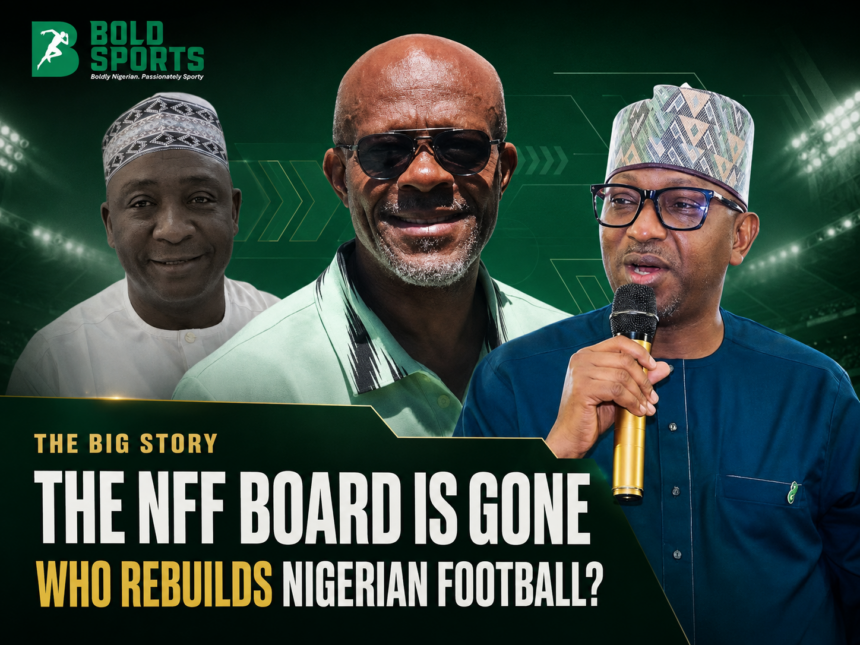
At the NFF Secretariat in Abuja on Thursday, Ibrahim Gusau brought an end to a week of speculation. He resigned as president of the Nigeria Football Federation.
Mohammed Sanusi also left as General Secretary, while members of the Executive Committee followed them out.
By the end of the day, the election scheduled for September 27 had been suspended and Emmanuel Ikpeme had been appointed interim General Secretary.
One uncertainty had been resolved. Another had taken its place. The question is no longer whether the leadership of Nigerian football is changing. It is who now has the authority to decide what replaces it.
More Read


An interim Secretariat is not a new board
Ikpeme was the NFF’s Deputy General Secretary before Thursday’s announcement. He has now been asked to oversee the Secretariat, with former Director of Media and Communications Ademola Olajire serving as interim Deputy General Secretary.
That provides administrative continuity.
National teams still have matches to prepare for. Domestic competitions must continue. Staff must be paid, correspondence answered and Nigeria’s relationships with FIFA and CAF maintained.
But the appointment does not make Ikpeme the president of the NFF or turn the Secretariat into a replacement Executive Committee.
Under the current NFF statutes, the Congress is the federation’s supreme and legislative body. The Executive Committee provides strategic direction and oversight, while the Secretariat handles executive, operational and administrative work.
The Secretariat is designed to implement decisions. It is not designed to replace the elected body that makes and supervises those decisions.
There is also a practical problem. The statutes say legal documents must be signed by the president and General Secretary. With the presidency vacant and the entire Executive Committee gone, the federation must explain how major contracts and authorisations will be handled during the transition.
The statutes point towards Congress
The NFF statutes provide a succession route when the presidency becomes vacant.
The First Vice-President should ordinarily deputise until the next Congress. If that position is also vacant, responsibility moves to the Second Vice-President and then the Third Vice-President.
That route cannot operate normally after the resignation of the entire Executive Committee.
Article 38 addresses a wider collapse.
It states that when more than half of the Executive Committee positions become vacant, the General Secretary should convene an Extraordinary Congress. The remaining members of the committee would ordinarily manage the federation’s daily affairs until elections are held.
There are no remaining members in this case. That leaves the interim General Secretary with an important administrative role, but it also makes the Congress difficult to avoid.
The Congress elects the president and Executive Committee. It also has the authority to amend the statutes and electoral rules that will govern any fresh election. The NFF has announced that the September election will no longer proceed and that a fresh process will begin after comprehensive reforms have been completed.
That may prevent the federation from rushing into an election under a structure it already intends to change. It also creates questions that must be answered.
Who will design the reforms? Who will approve them? When will the Congress meet? How long will the interim arrangement last?
Suspending an election may create time for reform. It should not create an open-ended period without elected oversight.
Changing the names will not change the system
The departure of Gusau and his board has created an opportunity to examine more than individual performance.
President Bola Tinubu’s reform directive identified governance, administration, stakeholder representation, domestic competitions, development pathways and accountability as areas requiring attention.
Those areas go to the structure of Nigerian football.
The current NFF Congress has 54 votes. The 36 state football associations and the Federal Capital Territory hold 37 of them.
That means the state associations retain a clear majority over the representatives of the professional leagues, clubs, players, coaches, referees, women’s football and other parts of the game.
State football associations are important to the development and administration of football across Nigeria. The question is whether one constituency should continue to hold enough votes to decide an election largely on its own.
If the constituency structure remains substantially unchanged, a new election could produce new names through the same political system.
Reform must therefore examine who gets a vote, how candidates reach the ballot and whether the Congress properly reflects the people and organisations responsible for playing, developing, financing and organising Nigerian football.
It should also examine the independence of the electoral bodies, financial disclosure requirements and the process for appointing national-team coaches and technical officials.
Changing the president without addressing those questions would be a reset, not a reform.
Why FIFA and CAF matter
The Federal Government cannot complete this process alone. The NFF statutes require the federation and its bodies to operate without undue external influence. Its Electoral Code also prohibits third-party interference and requires FIFA and CAF to be informed about the electoral process.
That does not mean the government has no interest in what happens.
Nigerian football receives public funding. National teams represent the country. The government has a legitimate responsibility to demand accountability for public money and the failures of institutions operating in Nigeria.
The difficulty is in turning that responsibility into reform without allowing the government to appoint football officials or control the federation directly.
The NFF statement announcing the transition says the reforms will be undertaken in consultation with FIFA and CAF. That consultation is essential.
FIFA has used normalisation committees in other countries where the leadership or governance of a member association has broken down. In those cases, FIFA and the relevant continental body have defined the committee’s mandate, selected its members and subjected them to eligibility checks.
No such committee has been officially announced for Nigeria.
Consulting FIFA and CAF is not the same as receiving approval for a particular structure. Until the institutions make their position clear, nobody should present a normalisation committee as a settled fact.
If one is eventually created, Nigerians should be told who appointed it, what it is authorised to do, how long it will remain and whether its members will be barred from contesting the election they organise.
The details will determine whether it is a reform body or simply another route to power.
The leagues cannot be left in uncertainty
Thursday’s changes extended beyond the NFF headquarters.
The chairmen, appointed directors and chief executives of the NPFL, NNL, NWFL and Nationwide League One were directed to hand over administration to their respective chief operating officers.
Where a chief operating officer is not an NFF employee, the interim General Secretary will deploy another member of staff from the federation.
The timing is particularly sensitive for the NPFL.
The league begins its 2026/27 season on Friday, with Shooting Stars hosting Inter Lagos in Ibadan. The remaining opening-round fixtures are scheduled for Sunday.
Only one day before the NFF leadership collapse, the league announced a three-year title-sponsorship agreement with EuroMatch worth $7.5 million.
The season can continue during the transition.
What cannot remain unclear is who now represents the league in that commercial relationship, who authorises payments to clubs and whether decisions already approved by the previous leadership remain in force.
Clubs, players and sponsors should not have to discover the answers through rumours.
The NFF Secretariat must identify the officers responsible for each league and define the limits of their authority.
What reform should produce
The success of this process will not be measured by how quickly a new president emerges.
It will be measured by what is different when the next president takes office.
A credible reform should produce clearer financial reporting, stronger independent oversight and a Congress that reflects the breadth of Nigerian football.
It should establish transparent processes for national-team appointments, player payments, development funding and the management of domestic competitions.
The federation’s audited accounts and major sources of public funding should be easier to scrutinise. Decisions about national teams should have identifiable responsibility. Reviews of failure should produce published findings and implementation deadlines.
The reform should also protect the progress that has been made.
The domestic league calendar has become more predictable. Coaching education and refereeing development cannot simply stop because the leadership has changed. National teams still have competitions to prepare for.
Reform should correct what is broken without paralysing what must continue.
The first requirement is a public roadmap
The NFF has confirmed the resignations, interim Secretariat and suspension of the September election.
The next announcement must explain the process.
Nigerians need to know when the Congress will meet, what authority the interim Secretariat holds and how FIFA and CAF are involved.
They also need the terms of reference for the reform process, the timetable for proposed changes and an indication of when a fresh election could take place.
That roadmap should include the domestic leagues and explain how financial, contractual and sporting decisions will be authorised during the transition.
An interim arrangement without a timetable can quickly become another source of uncertainty.
Last week, Nigerian football was being discussed through anonymous briefings and unconfirmed reports. The institutions have now placed some facts on the record. They must continue.
© Bold Sports Media. All rights reserved. If sharing, kindly credit Bold Sports as the source and include a link to the original post. Unauthorised use is prohibited.