

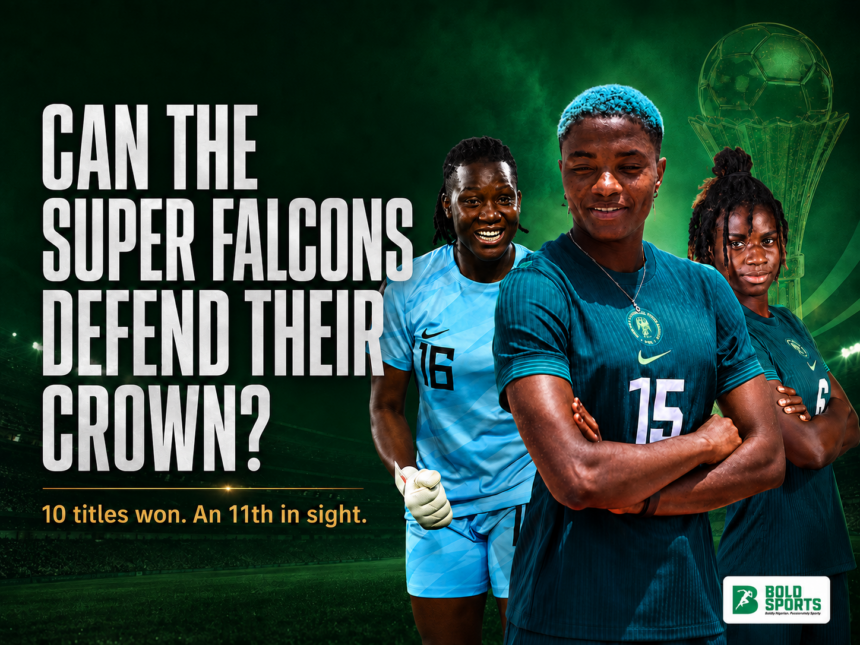
Nigeria begin the 2026 Women’s Africa Cup of Nations as defending champions, Africa’s highest-ranked team and the most successful country in the competition’s history. With 10 titles won, winning for the Super Falcons is now more of an expectation than ambition.
As recent editions of the WAFCON have shown, the Super Falcons won’t easily expect this campaign to be a continuation of last year’s celebration.
Owing to the growth of women’s football on the contient, the Confederation of African Football has increased the number of participating teams, with this year’s tournament having an expanded 16 teams for the first time. Nigeria’s group contains Zambia’s dangerous attack, a developing Egypt side and Malawi, whose first appearance comes with one of Africa’s most prolific forwards. Hosts Morocco remain desperate to win a first title, South Africa know what it takes to become champions, while Ghana and Cameroon return with squads capable of challenging the established order.
For Justine Madugu and his players, the task is clear: qualify for the 2027 FIFA Women’s World Cup and then give Nigeria another African title.
More Read




How they achieve it may be less straightforward.
From Mission X to title defence
Nigeria’s route to a record-extending 10th title in 2025 began with questions.
The Super Falcons had lost their opening matches at the two previous editions, while Morocco, South Africa and Zambia were closing the gap at the top of African women’s football. Madugu entered the tournament carrying the responsibility of restoring a team that had finished fourth in 2022.
Nigeria responded by controlling Group B.
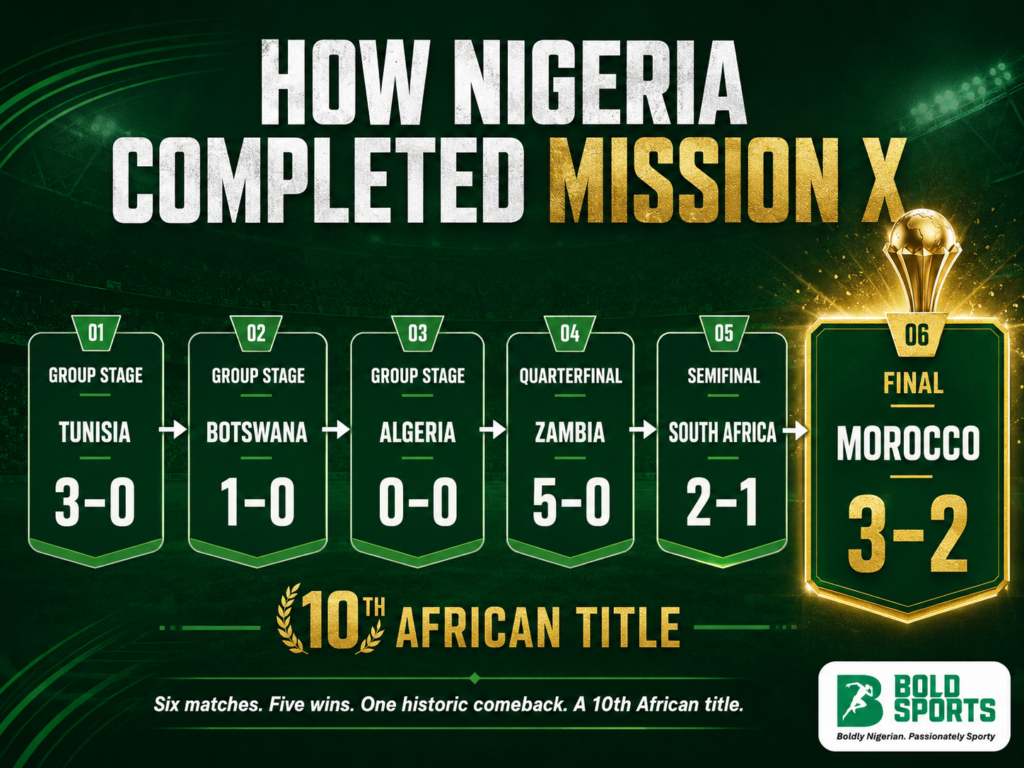
A 3–0 victory over Tunisia gave the Falcons the start they needed. They followed it with a 1–0 win against Botswana before a goalless draw with Algeria secured first place in the group without conceding a goal.
The knockout rounds revealed more of the team’s range.
Against Zambia in the quarterfinals, Nigeria produced their most dominant performance of the tournament, winning 5–0 against a team containing Barbra Banda and Racheal Kundananji.
The semifinal against defending champions South Africa required something different. Nigeria won 2–1, showing the patience and resilience needed to survive a tighter contest.
Then came the final against hosts Morocco.
Two goals down after 24 minutes and facing a home crowd in Rabat, Nigeria’s 10th title appeared to be slipping away. Instead, the Falcons produced one of the great comebacks in the competition’s history.
Esther Okoronkwo scored from the penalty spot, Folashade Ijamilusi equalised and Jennifer Echegini completed the turnaround late in the second half as Nigeria won 3–2.
It was the defining performance of Madugu’s tenure: a recovery built on tactical changes, squad depth and a group that refused to accept defeat.
That victory completed Mission X. This time, Nigeria are the team everyone wants to beat.
Nigeria’s Group C fixtures
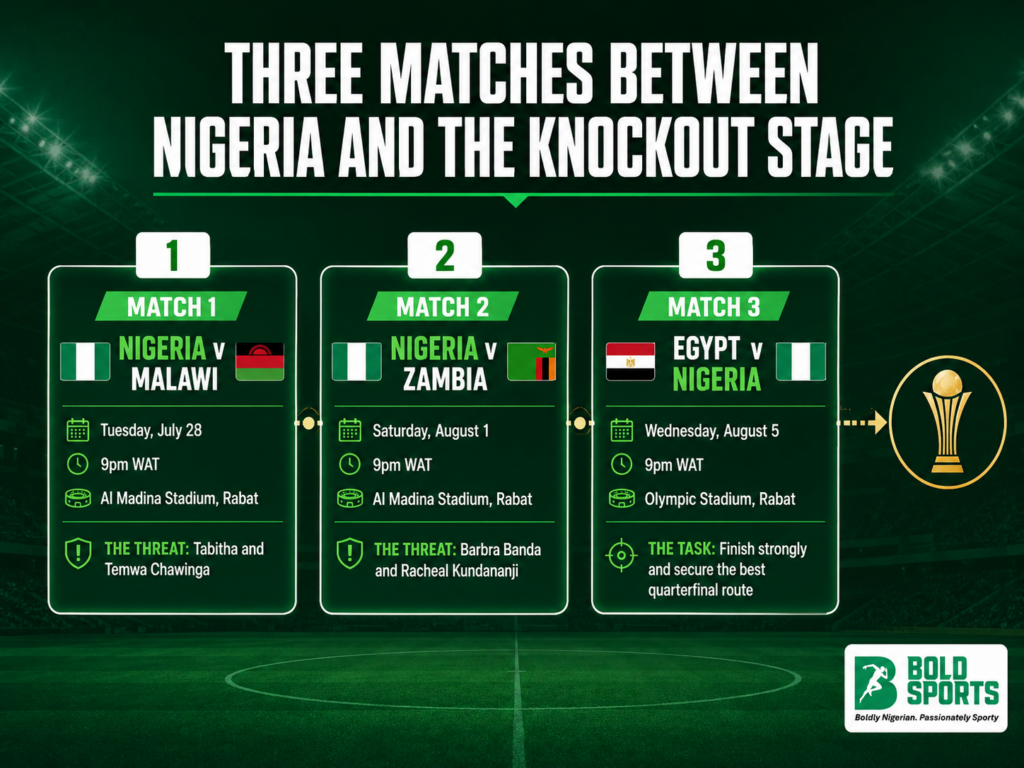
The Super Falcons begin against Malawi at the Al Madina Stadium in Rabat on Tuesday, July 28.
Their second match, against Zambia on August 1, is likely to be the defining fixture in the battle to win Group C. Nigeria complete the group stage against Egypt at the Olympic Stadium on August 5.
Nigeria v Malawi
Tuesday, July 28 | 9pm WAT
Al Madina Stadium, Rabat
Malawi are making their WAFCON debut, but Nigeria cannot afford to treat them like ceremonial newcomers.
The Scorchers possess an elite attacking threat in Tabitha Chawinga, whose speed, movement and finishing give Malawi the ability to punish defensive mistakes. Temwa Chawinga provides another direct threat and makes Malawi more dangerous than their lack of tournament experience suggests.
Nigeria should control possession, but the challenge will be breaking down a team likely to defend compactly while denying the Chawinga sisters space to counterattack.
An opening victory would allow Madugu to manage the group from a position of strength. Anything less would increase the pressure before the meeting with Zambia.
Nigeria v Zambia
Saturday, August 1 | 9pm WAT
Al Madina Stadium, Rabat
Zambia represent Nigeria’s strongest group-stage test.
The Copper Queens will still remember their 5–0 quarterfinal defeat last year. That result demonstrated Nigeria’s superiority on the day, but it did not erase the quality in Zambia’s attack.
Barbra Banda and Racheal Kundananji give Zambia pace, power and the ability to turn defensive situations into clear chances within seconds. If Nigeria’s full-backs advance at the same time or the midfield loses possession without adequate cover, Zambia have the players to exploit the space.
This match may determine who finishes top of Group C and secures what should be the more favourable quarterfinal route.
Egypt v Nigeria
Wednesday, August 5 | 9pm WAT
Olympic Stadium, Rabat
Egypt return to the tournament after missing the previous three editions and remain less experienced at this level than Nigeria.
However, the final group match could become complicated depending on the earlier results. Egypt may need a victory to reach the quarterfinals, while Nigeria could be trying to protect first place or manage players ahead of the knockout stage.
The Falcons should have too much quality if they move the ball quickly and impose themselves early. But tournament football often punishes teams that treat the final group match as a formality.
Madugu keeps the champions’ core
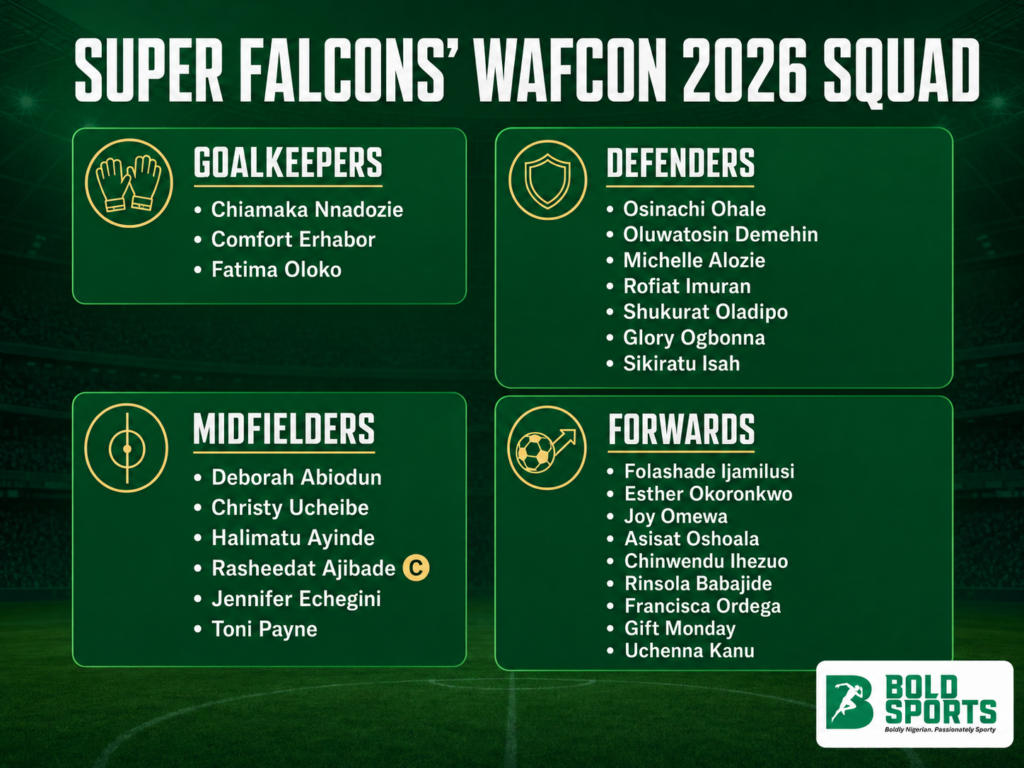
Madugu has selected 25 players for the title defence, retaining most of the group that won the competition last year.
Chiamaka Nnadozie remains the clear first choice in goal, supported by Comfort Erhabor and Fatima Oloko.
Osinachi Ohale brings experience to a defence that also includes Oluwatosin Demehin, Michelle Alozie, Rofiat Imuran, Shukurat Oladipo, Glory Ogbonna and Sikiratu Isah.
The midfield contains Deborah Abiodun, Christy Ucheibe, Halimatu Ayinde, Jennifer Echegini, Toni Payne and captain Rasheedat Ajibade, although Ajibade’s versatility means she is also likely to operate in the front line.
Madugu has devoted nine places to forwards: Folashade Ijamilusi, Esther Okoronkwo, Joy Omewa, Asisat Oshoala, Chinwendu Ihezuo, Rinsola Babajide, Francisca Ordega, Gift Monday and Uchenna Kanu.
The selection provides variety. Oshoala and Ihezuo can lead the line, Okoronkwo can create or finish, Babajide and Kanu offer width, while Ijamilusi and Echegini demonstrated last year that they can influence major matches from the bench.
The challenge will be turning those options into a settled attack.
Madugu must decide whether Oshoala remains his starting centre-forward or whether Okoronkwo’s combination play makes her a better fit through the middle. He must also determine where Ajibade can have the greatest influence: wide, centrally or moving between both areas.
There is enough attacking depth to change games. There may not be enough room to keep every established player involved.
Plumptre’s absence changes the defence
The most significant absentee is Ashleigh Plumptre.
The Al-Ittihad defender said her body was not ready to return to competition, ending speculation about why she was not included. Her absence removes one of Nigeria’s strongest aerial defenders and one of the team’s more composed players in possession.
Without her, Ohale and Demehin appear the most likely central-defensive pairing. Madugu could also use Shukurat Oladipo or Glory Ogbonna depending on the opposition and the physical demands of the tournament.
At full-back, Alozie’s attacking instincts give Nigeria an extra threat, but they can also leave space behind her. That will be particularly important against Zambia and Malawi, whose fastest players will look to attack the channels.
The balance around Nigeria’s full-backs may become one of Madugu’s most important tactical decisions. Sending both forward at the same time could overwhelm weaker opponents, but it would also expose the central defenders to counterattacks.
The midfield must control the risk
Nigeria’s strongest midfield may be built around Ucheibe, Abiodun and Echegini.
Ucheibe offers defensive discipline and protection in front of the back line. Abiodun brings energy, ball recovery and the ability to press. Echegini provides the attacking runs and goal threat that can turn possession into chances.
Ayinde offers experience and physical presence, while Payne can help Nigeria carry the ball through midfield and connect with the attack.
Madugu’s choice will depend on how much control he wants.
Against Malawi and Egypt, Nigeria may need an additional creative player to break down a compact defence. Against Zambia, the priority may be protecting the ball and preventing Banda and Kundananji from receiving early passes into space.
The Falcons were at their best last year when they could adjust during matches rather than rely on one fixed approach. That flexibility will again be important.
The players Nigeria will rely on
Nnadozie remains the foundation of the team.
The Brighton goalkeeper has repeatedly delivered in major international matches and gives Nigeria security when opponents break through the defensive line. Her communication will be even more important in a defence missing Plumptre.
Ajibade remains the team’s leader and most adaptable attacker. She was named Player of the Tournament last year and can influence matches through her pressing, movement, direct running and ability to create chances.
Okoronkwo enters the competition as another central figure after her decisive contribution to the 2025 title. She was involved throughout the comeback against Morocco and offers a combination of intelligence, technique and composure in the final third.
Echegini gives Nigeria a midfielder capable of arriving in the penalty area at the right moment, as she showed with the winning goal in last year’s final.
Then there is Oshoala.
The six-time African Women’s Player of the Year remains the most recognisable member of the squad. Nigeria may no longer need to build the entire attack around her, but her movement, experience and finishing can still decide important matches.
Madugu’s task is not to find one player to carry Nigeria. It is to make the different strengths within the squad complement one another.
Who can stop Nigeria?
Morocco may again be Nigeria’s strongest challenger.
The hosts have reached the last two finals, invested heavily in women’s football and will have home support throughout the competition. Ghizlane Chebbak remains one of Africa’s most influential attacking players, while Morocco’s technical quality and familiarity with the conditions make them serious contenders.
Their greatest burden may be psychological. They lost the 2022 final to South Africa and surrendered a two-goal lead against Nigeria in 2025. A third opportunity on home soil comes with enormous pressure.
South Africa cannot be discounted. Banyana Banyana were champions in 2022 and remain one of the continent’s most tactically organised teams. Even when they are not at their most fluent, they are difficult to eliminate.
Zambia possess perhaps the tournament’s most dangerous strike partnership in Banda and Kundananji. Their ability to score against any opponent makes them a title threat, although their defensive stability will determine how far they progress.
Ghana and Cameroon also return to the competition with the talent to disrupt the expected order, while Nigeria’s experience should ensure they do not fear any potential knockout opponent.
The road to Brazil 2027
The tournament is not only about becoming African champions.
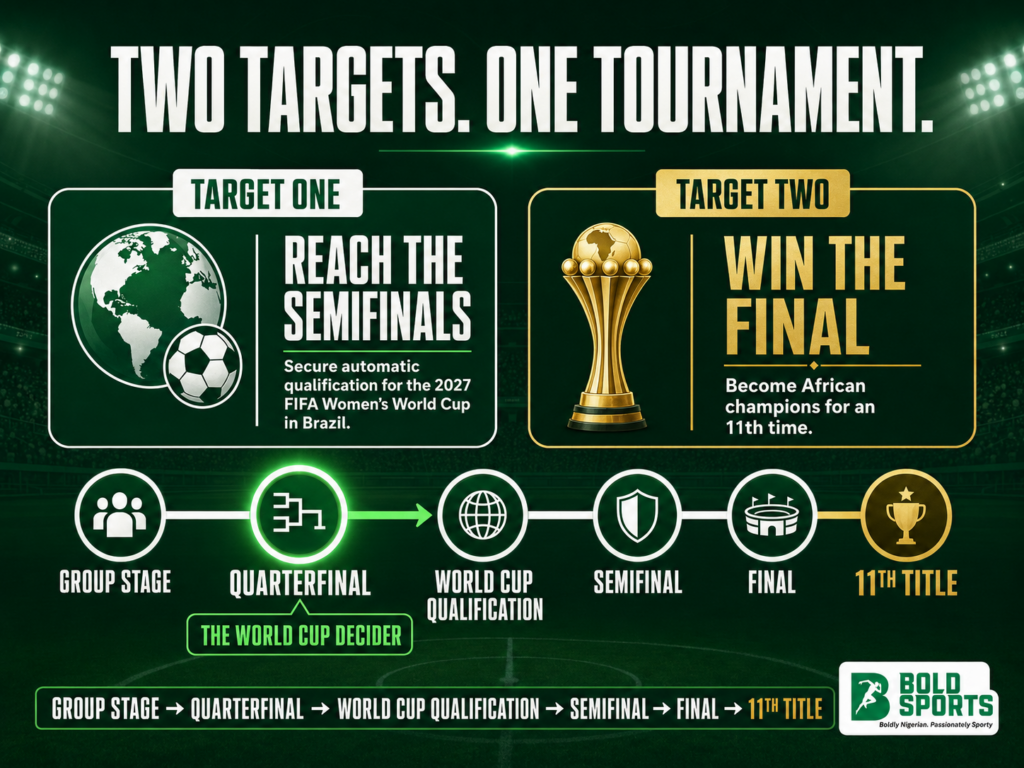
WAFCON 2026 will determine Africa’s representatives at the 2027 FIFA Women’s World Cup in Brazil. The four semifinalists will qualify automatically, while the losing quarterfinalists will enter playoff matches that determine Africa’s representatives in the intercontinental playoffs.
For Nigeria, the most direct route is simple: reach the semifinals.
That makes the quarterfinal potentially the most consequential match of the tournament. Winning Group C should provide a better route, with the group winners facing the runners-up from Group D. Finishing second would mean facing the winners of a group containing Ghana, Cameroon, Mali and Cape Verde.
Nigeria have appeared at every Women’s World Cup since the competition began in 1991. Protecting that record is the first non-negotiable objective. Winning an 11th African title comes after the World Cup place has been secured.
Promises still waiting to be fulfilled
Nigeria’s title defence begins with an unresolved issue away from the pitch.
The Super Falcons are still awaiting the full delivery of rewards announced by President Bola Tinubu after their 2025 triumph. Each player was promised the naira equivalent of $100,000, a three-bedroom home and a national honour. Members of the technical team were also promised financial and housing rewards.
The National Sports Commission says the rewards have been processed, with housing documents and national-honour certificates available for collection while the cash payments are being concluded.
But as the players begin another tournament, the promises attached to their previous success have not been completely fulfilled.
The delay should not be treated as an unavoidable part of Nigerian sport. Rewards announced publicly should be delivered promptly and transparently. Players preparing to represent the country again should not have to wonder when commitments made after their last success will be honoured.
The Falcons have become accustomed to separating administrative problems from their work on the pitch. Their ability to do so should not excuse the system responsible for those problems.
Bold Sports verdict
Nigeria have the squad to win WAFCON 2026, but they are not overwhelming favourites.
The Falcons possess the competition’s deepest group of attackers, an elite goalkeeper, experienced leaders and a coach who has already demonstrated the ability to make decisive changes under pressure.
There are also legitimate questions.
Plumptre’s absence weakens the defence. The full-back areas could be exposed by fast opponents. Madugu must establish the right midfield balance and choose an attacking combination from several players who expect significant roles.
The opening match against Malawi should be won, but it will test Nigeria’s ability to control counterattacks. Zambia will provide the clearest measure of the defence. Egypt will test the team’s concentration and squad management.
If Nigeria win Group C and avoid injuries to key players, they should reach the semifinals and secure World Cup qualification. From there, the title may again be decided by the Falcons’ ability to adjust during the difficult moments.
Morocco’s home advantage, South Africa’s organisation and Zambia’s attack make this a more open tournament than Nigeria’s historical dominance might suggest.
But no other country arrive with Nigeria’s combination of depth, experience and proof that they can survive when a final appears to be slipping away.
Bold Sports prediction: Nigeria to reach the final, with an 11th title a realistic, but far from guaranteed outcome.
© Bold Sports Media. All rights reserved. If sharing, kindly credit Bold Sports as the source and include a link to the original post. Unauthorised use is prohibited.